
Perception
Learn to separate sensation from assumption.
Sensory development starts with attention: recognizing what is actually perceived before interpretation, preference or scoring is added.
Education · Sensory Skills
Professional sensory skill develops through perception, references, repeated comparison, calibration and the disciplined interpretation of observations.
Practice environment
Cups, samples, references and independent observations create the conditions in which sensory ability can be compared, discussed and improved.
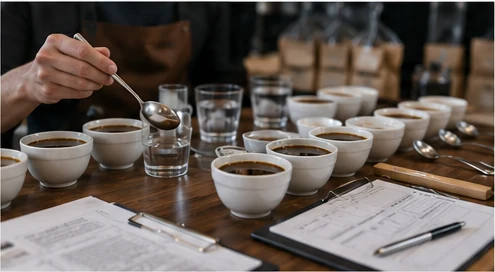
Structured preparation and independent evaluation create a stronger basis for discussion and calibration.
Learning architecture
The learning sequence moves from perception toward professional application rather than treating sensory skill as a list of descriptors.
Sensory development starts with attention: recognizing what is actually perceived before interpretation, preference or scoring is added.
Reference materials and comparative exercises make sensory language more concrete and help learners examine differences in recognition and intensity.
Repeated evaluation makes within-person variability and panel differences visible, giving calibration a diagnostic purpose rather than forcing consensus.
The objective is not vocabulary accumulation. It is clearer evaluation, communication and decision-making across coffee quality, roasting and education.
Professional application
Training can connect directly with sensory evaluation, cupping calibration, roasting and quality-system development.
Discuss sensory education