
Transformation
Understand what is physically changing.
Roasting progressively changes coffee through heat transfer, moisture loss, structural change and chemical reactions. Process interpretation starts with that transformation.
Education · Roasting
Roasting education becomes more useful when green-coffee condition, heat application, physical change, process information and sensory outcome are interpreted together.
Coffee transformation
Green coffee progressively changes through roasting. Visible state provides context for the thermal and sensory models that follow.
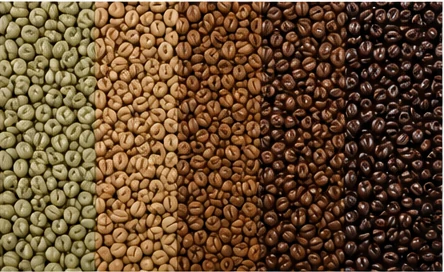
Visible changes in coffee accompany the thermal, chemical and sensory development explored during roasting.
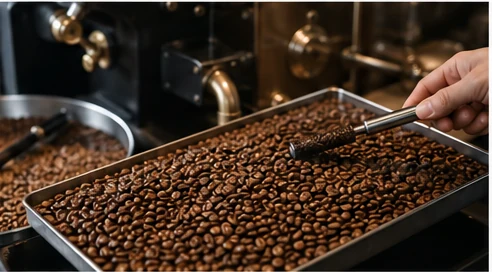
Roast decisions are evaluated through both process information and the coffee they produce.
Roasting framework
No single curve or profile can answer every roasting question. The learning system connects transformation, process, sensory outcome and controlled experimentation.
Roasting progressively changes coffee through heat transfer, moisture loss, structural change and chemical reactions. Process interpretation starts with that transformation.
Time, temperature and machine information help describe what occurred, but they only become useful when interpreted against the coffee, equipment and intended outcome.
Physical and process observations should be compared with sensory evaluation so roast decisions can be assessed by their actual product outcome.
Structured trials make roast development more informative by reducing simultaneous changes and making comparisons easier to interpret.
Colour and physical state provide visible evidence of a much larger thermal and chemical transformation.
Roast transformation
A conceptual view of coffee transformation during roasting. It shows relationships rather than fixed temperatures, timings or chemical thresholds.
Heat input creates the conditions for transformation, but more energy is not automatically better.
Moisture loss, expansion and structural change occur alongside complex chemical transformation.
The roasting process is managed to support an intended balance of development, structure and sensory expression.
Sensory evidence helps determine whether the roast achieved the intended result.
Conceptual educational model. Actual roast behavior depends on coffee, equipment, batch conditions, measurement system and roast strategy.
The roast is not finished at the machine. Physical observations and sensory evaluation complete the feedback loop.
Thermal transformation
Time, temperature and sensory outcome should be interpreted together. This chamber is an explanatory model rather than a roast recipe or a claim about universal stage timing.
Thermal process model
Initial green-coffee state
Progressive moisture loss
Increasing browning reactions
Rapid structural and thermal change
Continued roast transformation
A simplified process narrative. Actual roast behavior depends on coffee, machine, batch size, environmental conditions and measurement system.
Professional learning
Roasting education can connect directly with sensory evaluation, product development, production consistency and roastery quality systems.
Discuss roasting education